Clinics using Aura’s 3D Imaging Technology see over a 30% increase in patient treatment acceptance rates, thanks to its ability to simulate results and enhance patient confidence.
Traditionally, patient images were captured using 2D cameras. However, 3D imaging systems provide a more realistic representation of a patient’s face. 3D imaging technology allows practitioners to achieve a higher level of detail in evaluating patient facial characteristics.
The Advantages of 3D Imaging Technology in Aesthetic Practices
This type of technology enables objective measurements of facial features, including the depth and location of wrinkles, sunspots, telangiectasias, and pores. We can assess skin quality, measure facial aspects such as lips, and simulate post-treatment appearances for direct comparisons.
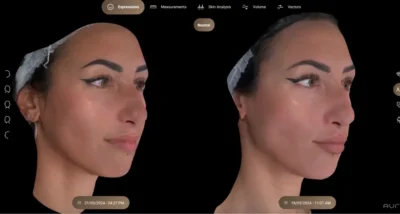
Aura: Revolutionising Facial Analysis with Advanced Features
The latest 3D imaging technology, AURA, surpasses other market equipment by capturing up to five different emotions in a single session: neutral, angry, surprised (useful for evaluating botulinum toxin results), smiling (useful for both botulinum toxin and dermal fillers), and kissing (essential for assessing lip filler treatments). The image quality is superior, and the acquisition speed is rapid, with a complete session taking only two minutes. The skin analysis function is crucial for evaluating a patient’s degree of photo-ageing. This was developed by training AURA’s AI with thousands of photographs, where developers rated skin parameters such as wrinkles, brown spots, and skin redness.
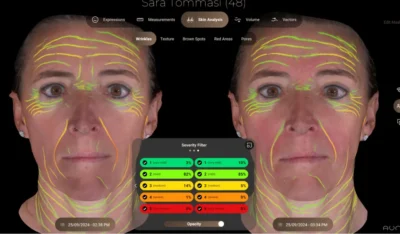
Additionally, the system offers two valuable tools. Firstly, volume comparison between images allows for the evaluation of the quantity of material injected in a session and its duration over time, preventing overfilling. Secondly, vector evaluation between images is essential after botulinum toxin treatments to assess the treatment’s effect.
Enhancing Patient Care and Communication with 3D Imaging
In my clinic, the first visit with a patient always includes an image acquisition by AURA. Either by a trained staff member or by me. The capture process is very easy and intuitive, both for me and for my patients. We have the patient sitting in front of the device, with a hair band to avoid distortions and perform all the required facial scans.
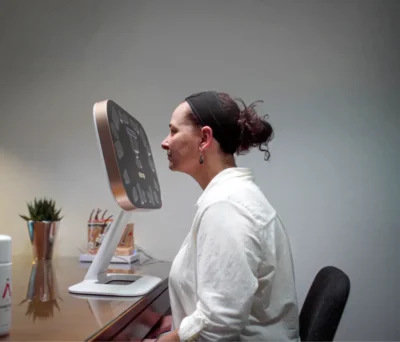
We then listen to the patient’s needs and reasons for visiting. Often, a patient may desire a dermal filler or biostimulation procedure, but the system’s skin analysis reveals poor skin texture, sunspots, or telangiectasias. In such cases, we perform a laser procedure to address these issues before proceeding with fillers in subsequent appointments. This tool is invaluable in helping patients understand their degree of photo-ageing.
I believe that 3D imaging is indispensable in medical aesthetics and plastic surgery practices because it offers numerous advantages over 2D methods. Most importantly, it enhances communication between doctors and patients regarding facial issues. AURA provides objective data and simulations, making it easier to explain procedure effects and helping patients understand the treatment path.
Aura’s 3D Facial Analysis Technology is user-friendly and can be used by both doctors and clinic staff, with all patient data stored together for easy retrieval. This improves consultation efficiency, professionalism, and follow-up appointment quality. Additionally, this image acquisition method serves as a valuable educational tool. We can take images, perform procedures such as dermal fillers, and compare before and after results. This continuous feedback loop helps identify areas for improvement, leading to better future treatment outcomes.
Fabrizio Vignoli is a Plastic surgeon in Bologna, Italy. He is a Member of the Executive Board of the Italian Society of Aesthetic Medicine.